
Improving Health Together Through Innovation
2026. 07. 08 15:33 GMT+0100
Budapest Business Journal – Pharma Industry Review – April 2026
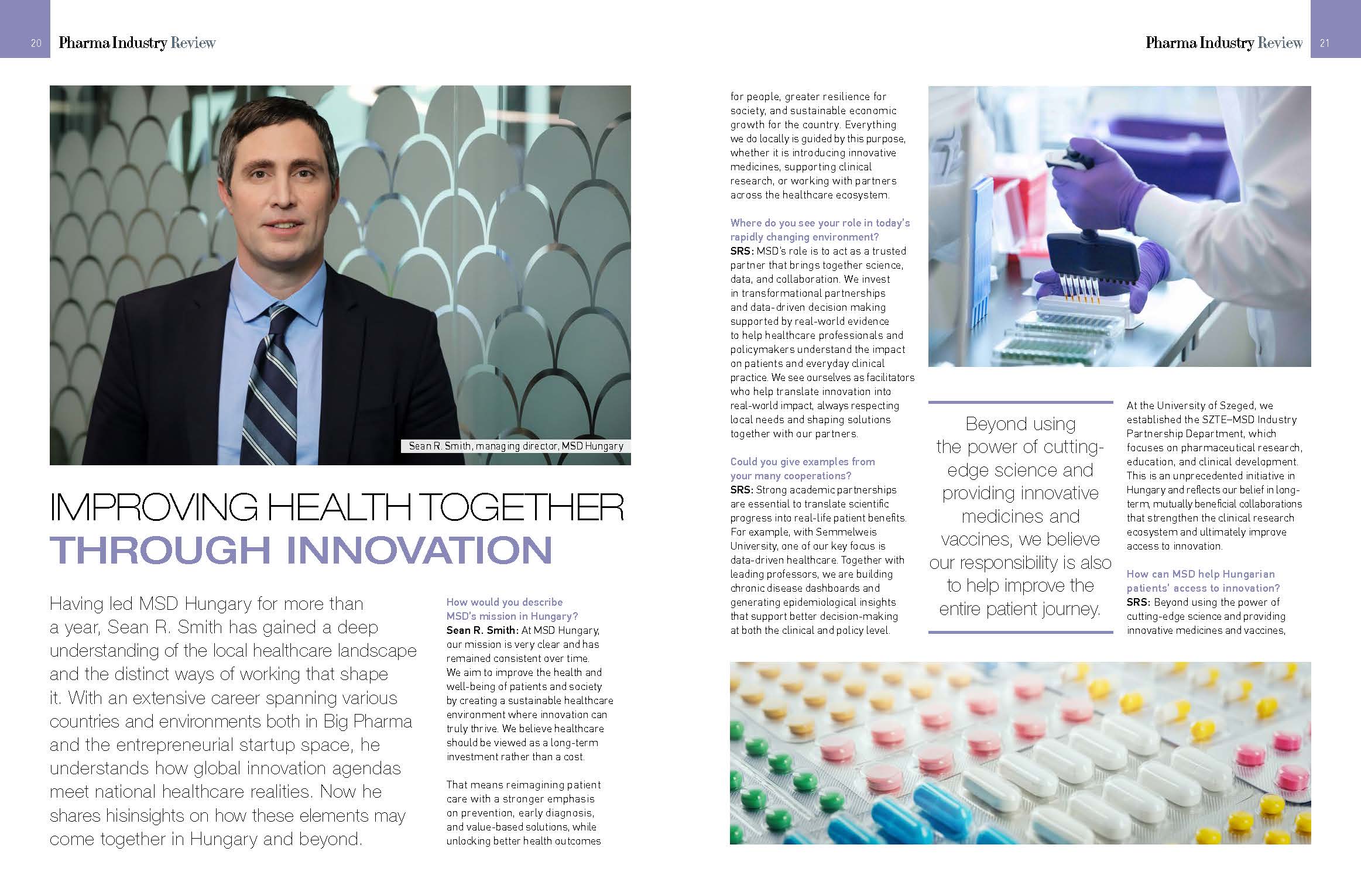
Having led MSD Hungary for more than a year, Sean R. Smith has gained a deep understanding of the local healthcare landscape and the distinct ways of working that shape it. With an extensive career spanning various countries and environments both in Big Pharma and the entrepreneurial startup space, he understands how global innovation agendas meet national healthcare realities. Now he shares his insights on how these elements may come together in Hungary and beyond.
How would you describe MSD’s mission in Hungary?
Sean R. Smith: At MSD Hungary, our mission is very clear and has remained consistent over time. We aim to improve the health and well-being of patients and society by creating a sustainable healthcare environment where innovation can truly thrive. We believe healthcare should be viewed as a long-term investment rather than a cost.
That means reimagining patient care with a stronger emphasis on prevention, early diagnosis, and value-based solutions, while unlocking better health outcomes for people, greater resilience for society, and sustainable economic growth for the country.
Everything we do locally is guided by this purpose, whether it is introducing innovative medicines, supporting clinical research, or working with partners across the healthcare ecosystem.
Where do you see your role in today’s rapidly changing environment?
SRS: MSD’s role is to act as a trusted partner that brings together science, data, and collaboration. We invest in transformational partnerships and data-driven decision making supported by real-world evidence to help healthcare professionals and policymakers understand the impact on patients and everyday clinical practice. We see ourselves as facilitators who help translate innovation into real-world impact, always respecting local needs and shaping solutions together with our partners.
Could you give examples from your many cooperations?
SRS: Strong academic partnerships are essential to translate scientific progress into real-life patient benefits. For example, with Semmelweis University, one of our key focuses is data-driven healthcare. Together with leading professors, we are building chronic disease dashboards and generating epidemiological insights that support better decision-making at both the clinical and policy level.
At the University of Szeged, we established the SZTE–MSD Industry Partnership Department, which focuses on pharmaceutical research, education, and clinical development. This is an unprecedented initiative in Hungary and reflects our belief in long-term, mutually beneficial collaborations that strengthen the clinical research ecosystem and ultimately improve access to innovation.
How can MSD help Hungarian patients’ access to innovation?
SRS: Beyond using the power of cutting-edge science and providing innovative medicines and vaccines, we believe our responsibility is also to help improve the entire patient journey. In Hungary, many patients face challenges related to timely diagnosis, fragmented care pathways, and delays in starting treatment. To address this, MSD developed the Patient Pathways Optimization Program, a non-promotional, hospital-focused partnership model.
The program supports multidisciplinary hospital teams in identifying bottlenecks in oncology care, improving coordination, and accelerating diagnosis-to-treatment timelines. With experience from more than 50 hospitals across Europe, it has already demonstrated measurable reductions in waiting times. In Hungary, we already have four active collaborations with current programs focusing on head and neck cancer and lung cancer, helping patients receive the right treatment at the right time.
Which global trends in healthcare provision do you consider most significant?
SRS: Two interconnected global trends stand out. The first is the need for sustained investment in medical innovation. Breakthrough therapies are redefining what is possible across many disease areas, but their true value can only be realized if health systems enable timely patient access to innovative therapies.
The second is the growing importance of early-stage oncology treatment in the curative setting. MSD supports this paradigm shift toward earlier intervention in cancer care. We advocate for investment in innovative cancer therapies in Hungary, as it can deliver substantial health and economic benefits.
Our recent analysis shows that starting immunotherapy treatments sooner, especially for certain types of cancer, doesn’t just improve life expectancy and quality of life; it also helps patients and their families remain more active in work and daily life. In fact, patients and caregivers could gain many more productive years together.
If every eligible patient received these new therapies available at an early stage in certain tumor types, Hungary could see a major impact: up to 31% fewer cancer recurrences, a 34% drop in the number of people needing treatment for advanced cancer, and a 30% reduction in cancer-related deaths after first event or recurrence, as well as a 23% decline in total deaths. 1
These improvements go beyond individual health. By stopping cancer from advancing, we can reduce the need for more intensive care later and help people stay engaged in their jobs and communities. This approach can also help the country save on healthcare costs in the long run, support workforce participation, and protect overall productivity.
In short, investing early in effective cancer treatment isn’t just a medical decision, it is an investment in Hungary’s future and its people. This is why we continue to advocate for policies and partnerships that support early diagnosis, timely access to innovation, and support evidence-based decision making across the oncology pathway.
References: 1 Ladino et al. Health and productivity benefits of anti-PD-(L)1 agents for early-stage cancer treatment in Hungary. (2026) J Med Econ, 29.
This article was made possible by MSD Pharma Hungary Kft., 1095 Budapest, Lechner Ödön fasor 10/B
+36-1-888-5300, hungary_msd@msd.com, Date of closing: 31/03/2026, HU-NON-02144